
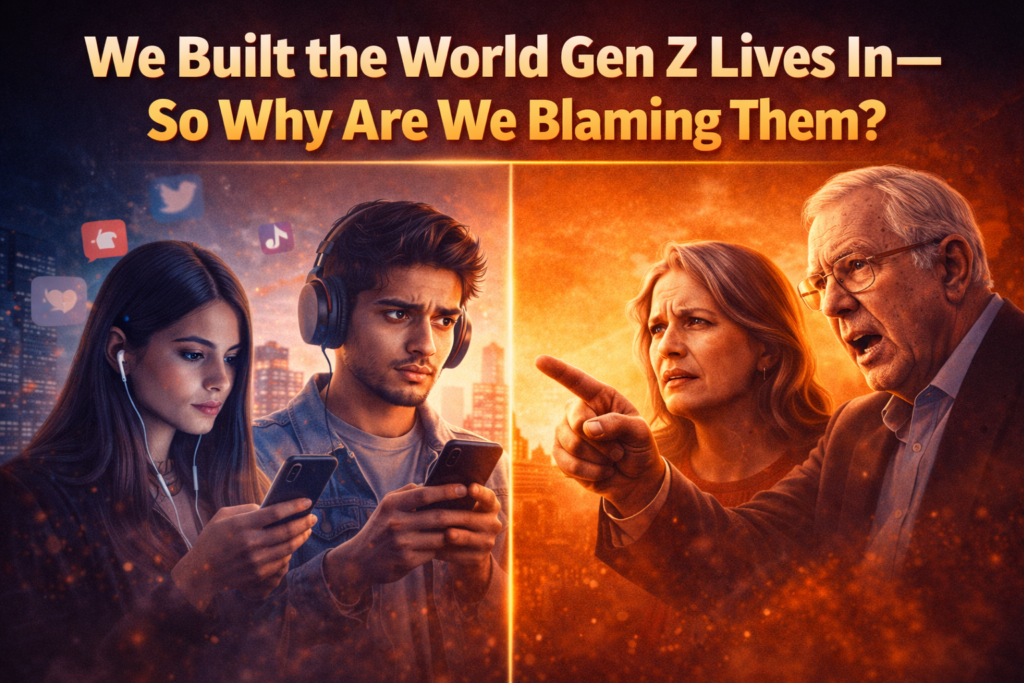
Short answer: Older generations in India built the attention economy, hustle culture, exam pressure, and the climate trajectory that Gen Z inherited. The behaviours we now criticise in them, including short focus, burnout pushback, and emotional openness, are responses to systems we designed. Gen Z is not broken; the world we handed them is.
The criticism of Gen Z has become almost ritualistic in India. Sit in any office cafeteria in Bengaluru, a corporate park in Gurugram, or even a family gathering in Mumbai, and you will hear the same complaints:
“They don’t focus.”
“They don’t want to work hard.”
“They quit too easily.”
“They are too sensitive.”
It is easy. Convenient, even. Blaming a generation often becomes a bonding exercise for the ones that came before.
But what if this narrative is incomplete? What if, instead of diagnosing a problem, we are looking at a consequence? What if Gen Z is not broken, but built?
Why does this frustration with Gen Z feel so familiar?
A few months ago, I was sitting in a workshop with a group of young professionals. The speaker was engaging, experienced, and genuinely insightful.
Yet, in the second row, a young participant was glued to their phone. Scroll. Pause. Glance up. Scroll again. It was distracting. Irritating, even.
For a moment, I caught myself thinking, this is exactly the problem with Gen Z.
Then a more uncomfortable thought crept in: Who designed the world where this behaviour feels normal?
Are the criticisms of Gen Z actually valid?
To be fair, not all criticism is baseless.
Short attention spans
India has some of the cheapest mobile data rates in the world, thanks to Reliance Jio. This democratised access to the internet, bringing millions online almost overnight. The result is a generation raised in an ecosystem of constant notifications, reels, and infinite scroll.
Studies globally suggest that the average human attention span has dropped significantly in the last decade, often attributed to digital consumption patterns (Microsoft Attention Span Study, 2015). But is this a Gen Z flaw, or a system-wide outcome?
Aversion to hustle culture
Older Indian generations glorified struggle.
- 12-hour workdays in IT firms
- Endless coaching classes for IIT-JEE or UPSC
- The pursuit of “secure” jobs over fulfilling ones
Burnout was worn like a badge of honour. Gen Z is pushing back. They are exploring freelancing, startups, and content creation. They question the idea that success must come at the cost of well-being. This is often labelled laziness. But what if it is a critique?
Emotional sensitivity and “too many boundaries”
Terms like therapy, triggers, and mental health are now part of everyday conversations among Indian youth. Older generations sometimes see this as over-sensitivity.
Yet, according to the World Health Organization, depression is a leading cause of illness among adolescents globally, and awareness is a critical first step toward addressing it. So, are they fragile, or simply more aware?
What did we actually build for them?
Here is where the narrative becomes uncomfortable.
The attention economy was engineered
The apps Gen Z uses daily were not accidental. They were built by some of the brightest minds, often from the very generations that now criticise them. Features like:
- Infinite scroll
- Push notifications
- Algorithmic feeds
are rooted in behavioural psychology. Their goal is to capture and retain attention. We did not allow distraction. We designed it.
We glorified burnout
In India, ambition often came with exhaustion.

“I haven’t slept in two days” was a flex. “Work-life balance” was seen as a lack of commitment. We normalised:
- Overwork
- Constant availability
- Productivity as identity
And now, when Gen Z says “No,” we call them unmotivated.
We deferred environmental responsibility
Consider cities like Delhi, where air quality often reaches hazardous levels. Gen Z did not create this reality. They inherited it.
Yet, when they speak about climate change, sustainable living, or ethical consumption, they are often dismissed as “idealistic.” Is it idealism, or accountability?
The promise of stability is crumbling
For decades, the formula was simple: study hard, get a degree, secure a stable job.
But today:

- Automation is reshaping entry-level jobs
- AI is replacing routine tasks
- Competition is global
The ladder that Millennials climbed is shifting beneath Gen Z’s feet. And still, we expect them to play by the same rules.
How does the Indian context make this harder?
India amplifies these challenges.
The housing dilemma
In cities like Mumbai and Bengaluru, skyrocketing rents make independence difficult. Owning a home, a milestone for previous generations, feels increasingly out of reach.
The exam-obsessed system
From a young age, Indian students are conditioned to compete:

- Board exams
- Entrance tests
- Competitive rankings
This system prioritises performance over exploration. Gen Z is beginning to question this model, not because they lack discipline, but because they are asking a deeper question: What is all this for?
Redefining relationships and identity
Indian Gen Z is also rethinking social norms.
- Delaying or rejecting traditional marriage timelines
- Challenging caste and gender expectations
- Embracing concepts like “situationships” and emotional compatibility
To older generations, this may seem like rebellion. At its core, it is reflection.
What is Gen Z actually getting right?
For all the criticism, there are areas where Gen Z may be ahead of the curve.
Mental health awareness
They are normalising therapy and emotional conversations in a country where such topics were once taboo. That is not weakness. That is progress.
Work-life balance
They are redefining success not just as income, but as sustainability. In a world facing burnout epidemics, this shift is not desirable. It is necessary.
Questioning the default script
Previous generations often accepted life templates:
- Study, job, marriage, family
Gen Z is questioning each step. Not rejecting tradition entirely, but asking why it exists.
A global yet rooted identity
Indian Gen Z is uniquely positioned. They are globally connected through technology, yet increasingly conscious of their cultural identity. This dual awareness gives them a perspective previous generations did not have.
The “Frankenstein moment”: a hard truth
There is a powerful metaphor in literature, Frankenstein. The tragedy is not the creation of the monster. It is the creator’s inability to accept what he has made.
In many ways, this reflects our relationship with Gen Z. We built the digital ecosystem, the hustle culture, the environmental trajectory, and the economic structures. And now, when Gen Z responds to these conditions in predictable ways, we label them flawed.
What is the more honest question to ask?
Yes, Gen Z has its challenges. Some struggle with resilience. Some avoid discomfort. Some rely too heavily on digital validation.
But the more important question is not What is wrong with them? It is: What does their behaviour reveal about the world we created?
The mirror we keep avoiding
Gen Z is not a problem to be solved. They are a signal. A reflection. A mirror held up to our choices, our systems, and our definitions of success.
And perhaps that is why the criticism feels so sharp, because somewhere, deep down, it feels personal. Instead of dismissing them, we might do better to listen.
Because in their refusal to blindly follow, in their insistence on questioning, and in their demand for balance, there lies something powerful: a chance not just to understand a generation, but to correct the trajectory of our own.
The real question is not whether Gen Z will adapt to the world. It is whether we are willing to adapt the world they inherited.
FAQs about Gen Z criticism in India
Why is Gen Z in India criticised so much?
Older generations often view Gen Z’s shorter attention spans, pushback against hustle culture, and openness about mental health as flaws. But many of these behaviours are responses to the digital ecosystem, exam pressure, and economic instability that earlier generations created or normalised.
Is Gen Z really lazier than previous generations?
No. Gen Z is rejecting burnout as a measure of worth. They are exploring freelancing, startups, and content creation, and asking whether 12-hour workdays in IT firms or endless IIT-JEE and UPSC coaching is the only definition of effort.
Why does Gen Z talk about therapy and mental health so openly?
Awareness is rising. The World Health Organization lists depression as a leading cause of illness among adolescents globally. Indian Gen Z is normalising therapy, triggers, and mental health language in a culture where these were taboo, which is a step forward, not a sign of fragility.
What pressures do Gen Z in India face that earlier generations did not?
Skyrocketing rents in Mumbai and Bengaluru, automation reshaping entry-level jobs, AI replacing routine tasks, and global competition all hit Gen Z harder. The old formula of study, degree, secure job no longer guarantees stability.
How should older generations respond to Gen Z differently?
By listening before labelling. Gen Z is questioning the default script of study, job, marriage, family, and asking why it exists. That questioning, paired with mental health awareness and a demand for balance, is a chance to fix systems, not punish a generation.