
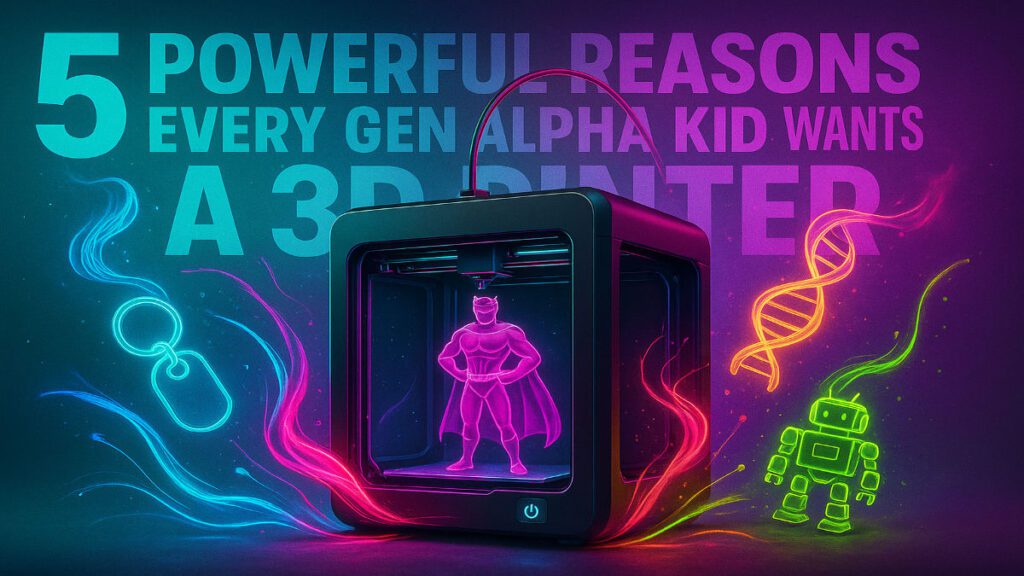
Short answer: A 3D printer for Gen Alpha kids is topping wish lists in India because it turns Minecraft and Roblox ideas into real objects, builds STEM and problem-solving skills, and offers tech-rich playtime away from endless scrolling. PwC projects 3D printing will be a core skill in 25% of STEM careers by 2030.
In 2025, birthday wish lists are shifting. Less about dolls or cricket bats, more about gadgets that help young minds create instead of only consume. Among all the cool tech tools out there, 3D printers are becoming the must-have gadget for Generation Alpha kids in India.
If you’re wondering why an 11-year-old in Bengaluru or a 9-year-old in Pune is dreaming about extrusion nozzles and filament rolls instead of action figures, you aren’t alone. Here’s why 3D printers have become the ultimate wishlist item for this creative generation.
Why do kids want to turn ideas into reality?
Gen Alpha is growing up where imagination meets interaction. They craft digital worlds in Minecraft and design outfits in Roblox, so they already speak the language of digital design. Here’s the kicker: a 3D printer lets them take those ideas off the screen and into their hands.
“I made a keychain with my initials and gave it to my dad for his birthday,” said 10-year-old Aarav from Hyderabad. “He still carries it with him.”
Creating something tangible, from a custom phone stand to a superhero figurine with a personalized cape, sparks a sense of ownership and pride. It’s creativity with purpose.
How does 3D printing build problem-solving skills?
Designing for 3D printing isn’t about clicking ‘print.’ It’s a journey. Gen Alpha kids learn about measurement, structure, material limits, and real-world constraints, and they enjoy the challenge.
When a print goes wrong (which happens often), they don’t give up. They tweak the design, rerun the process, and try again. This builds critical thinking and resilience, traits every parent and teacher values.
They’re picking up geometry and spatial reasoning without noticing. That’s experiential learning.
Why does STEM feel more fun with a 3D printer?
Ask any teacher: how do you make STEM subjects come alive for kids? The answer is simple: let them print it.
3D printing turns abstract STEM concepts into hands-on projects. Want to explain DNA structures? Print a helix model. Studying geography? Print a topographic map of the Himalayas. The lessons are interactive, memorable, and enjoyable.
As aerospace, architecture, and medicine integrate 3D printing into everyday workflows, early exposure gives Gen Alpha a head start. They aren’t only playing; they’re future-proofing their skill sets.
A 2023 report by PwC predicted 3D printing will be a core skill in 25% of STEM careers by 2030. That’s five years away.
How does 3D printing give screen time without the screens?
Parents across India worry about too much screen time. 3D printing offers a neat paradox: kids stay engaged with tech while staying away from mindless scrolling.
Designing, slicing, printing, and assembling a 3D object is immersive and tactile. Kids feel textures, watch the layers build up, and interact with their work. It’s experiential learning that a textbook or tablet can’t replicate.
“It’s like doing magic, but you’re the magician,” said 12-year-old Myra from Noida, who prints doll furniture and tiny kitchen sets.
Why is 3D printing a social hobby for Gen Alpha?
For Gen Alpha, sharing is essential. Whether it’s showcasing their latest print on Instagram (with mom’s help) or swapping designs with friends, 3D printing fuels a maker culture that’s collaborative, not competitive.
Websites like Thingiverse and Printables carry downloadable models and forums where kids remix each other’s ideas, leave feedback, and build community. It’s not only about making cool stuff. It’s about being part of something bigger.
The bottom line: 3D printers are more than toys
In a world where creativity, tech fluency, and adaptability are the new literacy, a 3D printer is more than a birthday present. It’s a launchpad for learning, a tool for expression, and a gateway to future innovation.
So next time you hear a Gen Alpha kid asking for a 3D printer, don’t brush it off as another expensive gadget. Treat it as an investment in curiosity, in education, and in the potential of a generation ready to shape the world, one printed layer at a time.
Parents, educators, and gift-givers, are you ready to help them build their future?
FAQs about 3D printers for Gen Alpha kids
Is a 3D printer a good gift for a 10-year-old in India?
Yes, with adult supervision. A 3D printer helps kids turn digital designs from Minecraft or Roblox into real objects, builds STEM skills, and offers tech-rich activity away from constant scrolling.
What skills do kids learn from 3D printing?
Kids pick up measurement, structure, material limits, geometry, spatial reasoning, critical thinking, and resilience from iterating when prints fail. These are transferable to STEM subjects and future careers.
Is 3D printing useful for a future career?
A 2023 PwC report predicted 3D printing will be a core skill in 25% of STEM careers by 2030, across sectors like aerospace, architecture, and medicine. Early exposure gives Gen Alpha an advantage.
Where can kids download 3D printing designs?
Thingiverse and Printables are popular communities with free downloadable models and forums where kids can remix each other’s designs, share feedback, and build with peers.
Does 3D printing reduce screen time?
It shifts screen time from passive scrolling to active making. Kids still use a screen to design, but the process moves into physical building, assembly, and iteration, which is more tactile and focused.