
Short answer: Gen Z AI tools at work are reshaping Indian offices in 2025. A Canva survey found 78% of Gen Z professionals in India want to experiment more with AI, and many already use unapproved tools. The shift is forcing companies to rethink ownership, quality control and training.
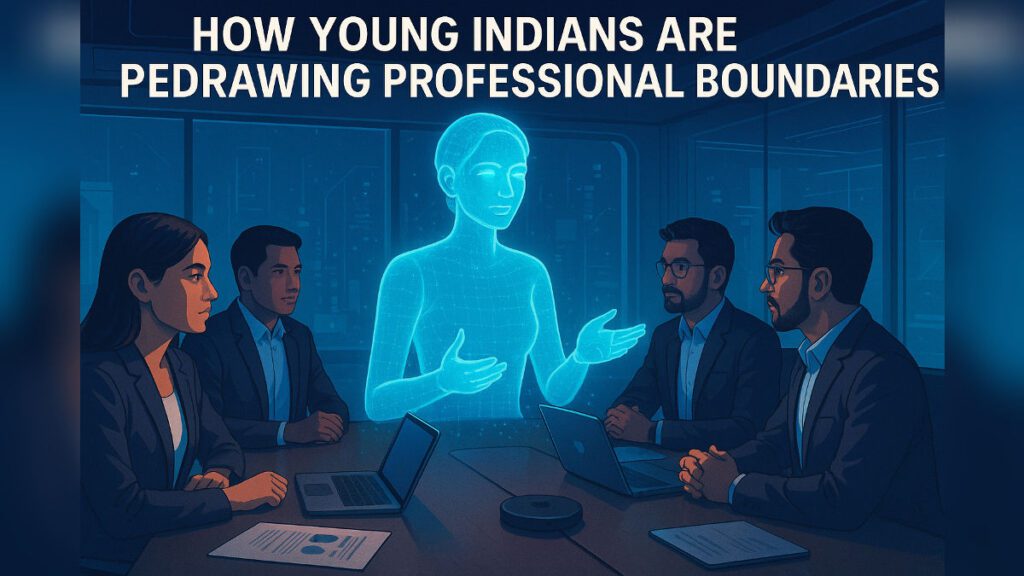
Picture a workspace where your colleague is an AI bot that drafts reports, suggests visuals or refines your pitch deck in seconds. That future is already here. In 2025, young professionals in India — especially Gen Z — are not just adapting to AI tools. They’re forcing workplaces to change around them. A recent survey by Canva found that 78% of Gen Z professionals in India want to experiment more with AI at work, and many already use unapproved AI tools to get things done.
This shift raises hard questions: Who owns the AI-generated content? Does creativity get diluted? How do organizations keep up? Here’s how Gen Z is rewriting the rules of work with AI.

Why does Gen Z embrace AI tools at work?
- Speed and efficiency: Gen Z grew up expecting instant help from Google, TikTok tutorials or quick chat replies. At work, AI replaces waiting on others for drafts or ideas.
- Creative boost, not replacement: Many see AI as a co-creator. It helps with outlines, visuals and iterations, while the human adds voice, nuance and judgment.
- Lower entry barrier: You don’t need to be a design expert or coder. With AI, someone with basic skills can produce better visuals, reports or marketing material.
- Side hustles and freelance gigs: Young professionals juggle multiple streams. AI tools let them deliver quality work faster on freelancing platforms.
What does the Canva survey reveal about Gen Z and AI?
According to the Canva “State of Visual Communication” report:
- 78% of Gen Z professionals in India want to explore AI more in their jobs.
- Many admit they already use unapproved AI tools in creative workflows.
- Teams juggle 11-12 platforms weekly for visuals and content work.
The numbers show an era of friction: young professionals push for AI, while legacy structures aren’t ready.

Where do old workplace rules clash with new AI demands?
Control and ownership
If an intern uses ChatGPT to write a report, who owns it? The company? The intern? The AI’s “contribution”? Many companies haven’t defined these lines.
Quality and authenticity
AI outputs can be generic or echo existing content. Gen Z has to guard originality, voice and factual accuracy, or risk producing bland, unsafe work.
Regulation and compliance
In regulated industries like health, finance and legal, AI mistakes can be costly. Companies must set guardrails: AI use policies, review steps and version control.
Resistance from traditional leadership
Older leaders often distrust AI or see it as a threat to jobs. Gen Z has to prove that AI augments productivity instead of replacing people.
How are forward-thinking companies adapting?
- “AI assistants” in teams: Teams now include roles like “AI reviewer” who checks AI contributions before finalising.
- Sandbox environments: Departments maintain separate AI play zones to experiment without client risk.
- Internal training and governance: Workshops on prompt writing, ethical use and data privacy.
- Credits and attribution: Some firms require employees to flag which parts of deliverables were AI-generated.
These are early moves, but necessary ones to bridge creative ambition and operational safety.
Real stories: Gen Z pushing the envelope with AI
- A junior marketer used AI to design 5 campaign visuals in minutes and got them approved, raising her value on the team.
- A content writer offered clients AI-assisted drafts, then polished them, doing more quantity with higher margins.
- A product manager prototyped wireframes with AI and validated them with stakeholders faster than traditional design cycles.
These stories point to a new professional playbook: AI + human synergy rather than human vs AI.
How is AI changing work’s DNA?
- Skill sets redefined: Prompt engineering, AI oversight, data validation and communication will become core go-to-market skills, not optional extras.
- Evolving job roles: Some junior creative jobs may vanish, but new roles like AI curator, content ethics lead and AI maintenance will emerge.
- Speed and innovation cycles: Product development, marketing campaigns and iteration cycles will shorten. Speed becomes a competitive edge.
- Work value rebalanced: Because AI handles repetitive, lower-level tasks, human work shifts more toward strategy, empathy, storytelling and judgment.
The takeaway
Gen Z in India isn’t just adopting AI. They are forcing workplaces to reimagine norms. Tools like ChatGPT, image generators and code assistants are catalysts. The real revolution is cultural: how we define work, authorship and creative ownership is changing fast.
Enter 2026 and beyond: teams that embrace AI plus human fusion, set clear policies and encourage experimentation will lead. Those that cling to legacy will lag, and Gen Z is already past waiting. They’re building that future themselves.
FAQs about Gen Z AI tools at work
What percentage of Gen Z professionals in India want more AI at work?
According to Canva’s “State of Visual Communication” report, 78% of Gen Z professionals in India want to experiment more with AI in their jobs, and many already use unapproved AI tools.
Which AI tools do young Indian professionals use most?
ChatGPT for drafts and reports, image generators for visuals and code assistants for prototyping are the most common. Many teams juggle 11-12 platforms weekly for visuals and content work.
Who owns AI-generated content at work?
Most Indian companies haven’t defined this clearly. Some now require employees to flag which parts of deliverables are AI-generated, while others appoint AI reviewers and publish internal AI use policies.
Will AI replace junior jobs in India?
Some repetitive junior creative roles may shrink, but new roles are emerging — AI curator, content ethics lead, prompt engineer and AI maintenance. The net shift is toward strategy, empathy and judgment work.
How can Gen Z use AI responsibly at work?
Learn prompt writing, verify AI outputs for accuracy, follow company data privacy rules, attribute AI contributions and treat AI as a co-creator rather than a ghostwriter.