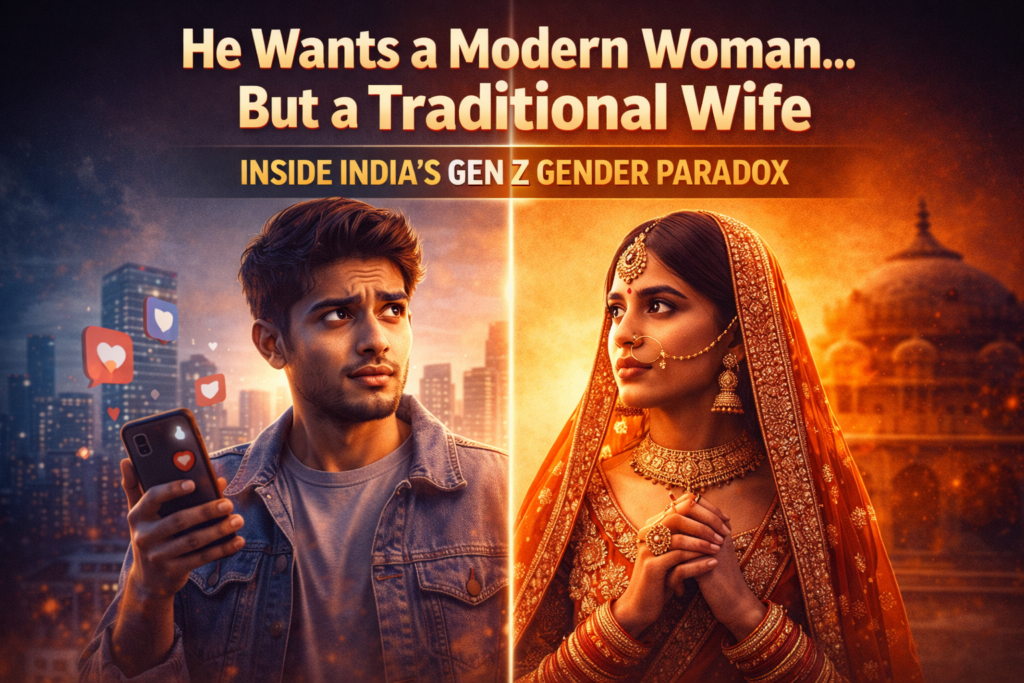
Short answer: Indian Gen Z is living a gender paradox. A 2026 Ipsos and Global Institute for Women’s Leadership survey shows that over 50% of young Indian men believe a wife should obey her husband, while Gen Z women are moving fast towards financial independence and equality. The result is a collision of worldviews shaped by economics, culture, and shifting identity.
A classroom conversation that gets uncomfortable fast
A few months ago, in a classroom full of PGDM students, I asked what I thought was a straightforward question:
“Would you be okay marrying someone who earns more than you?”
The room reacted the way you would expect. Some laughter. A few confident “yes” answers. A couple of thoughtful pauses.
Then I asked the follow-up:
“Would you be okay if your partner expects equal say in all major life decisions?”
Something shifted. Not dramatically. No one stormed out. No one argued loudly. But the energy in the room changed, quietly and clearly.
If you spend enough time around Gen Z, you learn to read these shifts. That silence, that hesitation, is where the real story lives.
What is the big Gen Z gender paradox?
For years we have been told Gen Z is the most progressive generation ever. More open. More inclusive. More equal.
In many ways that is true. But the data is more complicated.
A 2026 survey by Ipsos and the Global Institute for Women’s Leadership found:
- Nearly 1 in 3 Gen Z men globally believe a wife should obey her husband.
- In countries like India, that number rises to over 50%.
At the same time:
- A majority of Gen Z women strongly reject this view.
- Over half identify as feminists.
- Many actively support women in leadership roles.
The contradiction:
- Men leaning traditional.
- Women moving progressive.
- Both coexisting in the same generation.
This is not a difference in opinion. It is a collision of worldviews.
Why is this paradox sharper in India?
If it feels like a global trend, in India it becomes something sharper. More visible. More intense.
Data from Pew Research Center suggests that a large majority of Indians still believe:
👉 Men should be the primary financial providers in a household.
Layer that with what is actually happening on the ground:
- Women are more educated than ever.
- Female participation in higher education is rising.
- Career ambition among young women is no longer optional, it is expected.
But expectations have not caught up. Many young men today are, consciously or not, looking for a partner who is:
- Educated
- Earning
- Ambitious
But also:
- “Adjusting”
- Family-first
- Not “too independent”
👉 In other words: modern capability, traditional behaviour.
That is where things start to break.
Is the male breadwinner model collapsing in India?
To understand the tension, look at the male breadwinner model. For decades it shaped how Indian families worked.
- The man earns.
- The woman manages the home.
Simple. Predictable. Socially reinforced.
That model is now under pressure. According to CMIE:
- Youth unemployment remains persistently high.
- Stable, long-term jobs are harder to secure.
At the same time:
- Cost of living has risen.
- Urban housing has become significantly less affordable.
- A single income rarely supports a middle-class lifestyle.
👉 The reality is unavoidable. Most young men today cannot realistically be sole providers, even if they want to be.
What happens when identity does not match reality?
This is where the conversation moves from economics to psychology. For generations, masculinity in India was built around a simple equation:
“If you provide, you lead.”
But what happens when that equation breaks? What happens when:
- You are expected to lead.
- But you cannot fully provide.
That gap creates discomfort. Over time, discomfort hardens into something deeper:
👉 Status anxiety.
It is not always visible. It does not always show up in words. But it drives behaviour, decisions, and expectations. Instead of adapting to new realities, people often try to recreate old structures in new ways.
What is the “hybrid expectation” from a partner?
This is where the contradiction becomes most visible. Many Gen Z men today seem to want a partner who is:

- Financially independent
- Professionally successful
- Socially confident
But also:
- Respectful of traditional hierarchy
- Willing to “adjust”
- Less dominant in decision-making
👉 A hybrid expectation. Modern on the surface. Traditional at the core.
And here is the problem. That version of a partner is rare, because it asks women to evolve in one direction publicly and regress privately.
Why are Gen Z women moving faster?
Spend time on any Indian campus and the shift is hard to miss. Gen Z women today are:

- Career-oriented
- Financially aware
- More assertive about personal choices
They are delaying marriage. They are prioritising independence. They are questioning norms that earlier generations accepted without hesitation.
Many are no longer asking: 👉 “How do I fit into a system?”
They are asking: 👉 “Does this system work for me at all?”
Increasingly, the answer is: not really.
How wide is the gap between Gen Z men and women?
What we are seeing is not just a difference. It is a divergence. Men and women within the same generation are:
- Consuming different narratives
- Forming different expectations
- Imagining different futures
Global studies, including those by the World Economic Forum, show widening gender gaps in attitudes toward work, leadership, and equality.
In India, this gap is amplified by:
- Family structures
- Cultural expectations
- Marriage norms
👉 This is no longer just about relationships. It is about how an entire generation negotiates identity.
Is social media the cause or just the amplifier?
It is easy to blame social media. Platforms do play a role. On one side:
- Conversations around feminism
- Financial independence
- Self-growth
On the other:
- Content promoting dominance
- Nostalgia for “traditional roles”
- Simplified, often misleading narratives about gender
👉 Both realities exist online. Many young men are stuck between them, trying to reconcile conflicting ideas about what it means to be a man today.
Why this is not a gender war
Let us be clear. This is not about blaming men. It is not about idealising women.

It is about understanding a transition that is happening unevenly.
- The economy has changed.
- Opportunities have shifted.
- Gender roles are evolving.
But identity, the way we define ourselves, takes longer to catch up. And when change is uneven, tension is inevitable.
What question should we be asking?
Instead of asking: 👉 “Why are Gen Z men still traditional?”
We should be asking: 👉 “What new definition of masculinity are we offering them?”
Right now, many young men are stuck between:
- Old expectations they cannot fully meet
- New expectations they do not fully understand
Without a clear alternative, they fall back on what is familiar, even when it no longer works.
What happens next in relationships and society?
This tension is already shaping real outcomes:
- Marriages are being delayed.
- Compatibility expectations are changing.
- Relationship conflicts are becoming more visible.
Over time, this will influence:
- Workplace dynamics
- Household structures
- Social norms
And perhaps most importantly, how the next generation defines partnership itself.
A personal reflection
After that classroom discussion, a student stayed back to talk. He said something simple but honest:
“Sir, I’m okay with my partner earning more… but I don’t know how that would feel in real life.”
That sentence stayed with me. It captures the essence of this moment. It is not resistance. It is uncertainty. And uncertainty is far more complex than disagreement.
The future is neither traditional nor modern, it is unwritten
We often frame this conversation in binaries:
- Traditional vs progressive
- Old vs new
Reality is rarely that neat. We are not replacing one system with another. We are building something new, without a blueprint.
A future where:
- Men are not defined only by income.
- Women are not restricted by domestic roles.
- Relationships are negotiated, not assumed.
Getting there requires something difficult: 👉 letting go of scripts we have been taught our entire lives.
This is an identity shift, not a conflict
India is not moving backward. But it is not moving forward uniformly either. In that uneven transition:
- Expectations clash.
- Roles blur.
- Identities get questioned.
That is not necessarily a bad thing. Every meaningful shift begins with discomfort.
One line to remember
This is not a gender war. It’s an identity crisis shaped by economics, and we’re all trying to figure it out in real time.
Call to action
If you are reading this as a student, a founder, or someone navigating relationships today, pause and reflect:
- What do I expect from a partner?
- Where do these expectations come from?
- Do they still make sense today?
The answers will not just shape your personal life. They will quietly define the future of work, relationships, and society in India.
FAQs on India’s Gen Z gender paradox
What is the Gen Z gender paradox in India?
It is the contradiction where young Indian men want a partner who is educated, earning, and ambitious, while still expecting her to be adjusting, family-first, and not too independent. Modern capability is wanted on the surface, traditional behaviour underneath.
What percentage of Indian Gen Z men believe a wife should obey her husband?
A 2026 survey by Ipsos and the Global Institute for Women’s Leadership found that over 50% of Indian Gen Z men believe a wife should obey her husband, compared with nearly 1 in 3 Gen Z men globally.
Why is the male breadwinner model breaking down in India?
Youth unemployment remains high, stable long-term jobs are harder to secure, cost of living has risen, and urban housing has become less affordable. A single income rarely supports a middle-class lifestyle, which makes the sole provider model unrealistic for most young men.
How are Indian Gen Z women different from Gen Z men?
Gen Z women in India are delaying marriage, prioritising independence, and questioning traditional norms. They are more career-oriented, financially aware, and assertive about personal choices than earlier generations.
Is social media the cause of the Gen Z gender divide?
Social media amplifies the divide rather than creating it. Platforms carry both feminist and traditionalist content, which leaves young men trying to reconcile conflicting ideas of masculinity while women move ahead with clearer expectations of equality.