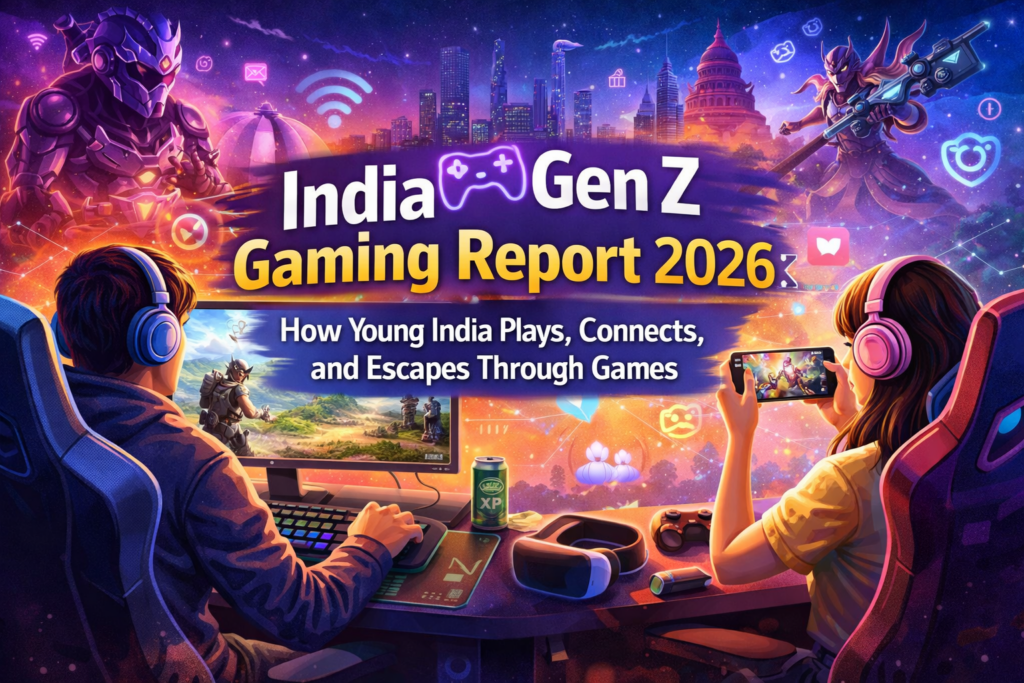
Short answer: Gaming is now a daily habit for Gen Z in India, not a hobby. A YouthTalks pulse survey of 100 respondents aged 18–28 found 89% play on smartphones, 64% play every day, and 58% come from Tier 2 and Tier 3 cities. Spending is still low, but engagement is high and social.
How did gaming go from “timepass” to default behaviour?
Not long ago, gaming in India carried a stigma. Parents saw it as a distraction. Teachers warned against it. Peers labelled it “timepass.” Walk into any college hostel today, or scroll through a late-night Discord server, and you see a different picture. Gaming isn’t only alive. It is thriving.
It has become a deeply embedded part of Gen Z’s lifestyle, shaping how young people unwind, socialise, compete and express themselves. What used to be a solitary activity is now a shared cultural experience, powered by smartphones, cheap data and a generation that is natively digital.
From late-night sessions on Battlegrounds Mobile India to quick matches on Free Fire MAX between classes, gaming has slotted into daily routines.
To understand this shift, YouthTalks conducted a pulse survey of 100 Gen Z individuals (aged 18–28) across both metro and Tier 2 cities in India. The findings were revealing, and in many ways, inevitable.
Gaming is no longer a hobby. It is a default behaviour.
Why is mobile gaming dominant in India?
One characteristic defines India’s gaming ecosystem: mobile dominates everything.
According to our survey, 89% of respondents primarily use smartphones for gaming.
That’s no surprise. India skipped the console-heavy evolution seen in Western markets and moved straight to mobile. Affordable Android devices, low-cost internet plans and app-store culture have put gaming in the hands of millions. You don’t need expensive hardware. You need a phone and a little free time.
Popular titles include:
- Battlegrounds Mobile India
- Call of Duty Mobile
- Free Fire MAX
These are household names among Gen Z.
I remember a conversation with a student in Lucknow who laughed when I asked if he owned a console. “Why would I need one?” he said. “My phone does everything.” That sentiment is widespread.

Mobile gaming isn’t only convenient. It is democratic. It has brought gaming to small towns, to first-time internet users, and to people who never considered themselves “gamers.”
How often does Gen Z play games?
The survey’s most striking finding is the frequency of gaming.
- 64% of respondents play games daily
- 22% play 3–5 times a week
This isn’t occasional entertainment. It is routine. For many young Indians, gaming follows a rhythm:
- A quick match after classes
- A longer session at night
- Casual play during the commute or downtime
Gaming fills the gaps in the day. Unlike movies or series, which demand uninterrupted attention, games bend to your schedule. 10 minutes or 2 hours, either works. Over time, that flexibility turns gaming from an activity into a habit loop.
Is gaming the new social network?
If you think gaming is a solitary experience, Gen Z would strongly disagree.
71% of respondents prefer multiplayer or team-based games.
Gaming today is less about playing alone and more about playing together.

Through squads, voice chats and in-game collaboration, players build friendships, stay connected and share experiences in real time.
Globally, studies suggest that nearly 78% of gamers believe gaming helps them make new friends. In India, that rings especially true.
Gaming has become the new café, the new hangout spot, the new social layer. And unlike physical spaces, it has no geographical boundaries.
Why does Gen Z play? Beyond entertainment
When asked why they game, respondents gave answers that went beyond “fun.”
Top motivations included:
- 52% → Reducing boredom
- 47% → Stress relief
- 39% → Social connection
- 34% → Competitive thrill
Gaming is being used as a coping mechanism, a mental reset button and a source of achievement. In a fast-paced, often stressful environment, gaming offers a sense of control, something many young people crave.
Where is gaming growing in India? The rise of Bharat
One of the most compelling shifts in Indian gaming is where growth is coming from.
58% of respondents were from Tier 2 and Tier 3 cities.
Metros like Bangalore, Mumbai and Delhi remain important. But the real momentum is building elsewhere. Cities like Jaipur, Lucknow, Indore, Pune and Hyderabad are emerging as gaming hubs.
The shift is driven by:
- Affordable internet
- Increasing smartphone penetration
- Limited alternative entertainment options
Gaming is no longer urban elite. It is mass India behaviour.
The monetisation gap: high engagement, low spend
Despite high engagement, spending stays low.
- 62% spend less than ₹500 per month on gaming
- Only 14% spend more than ₹1,000
That reflects a key challenge in the Indian gaming ecosystem. Users are highly active but not highly monetised. The reasons:
- Price sensitivity
- Free-to-play game models
- Limited disposable income
India has one of the largest gamer bases globally, but relatively lower revenue per user.
Is gaming also spectator entertainment?

Gaming is no longer only something you do. It is also something you watch.
49% of respondents watch gaming content weekly.
Platforms like YouTube and Loco have turned gaming into a spectator sport. Streamers today are entertainers, influencers and community builders. That has opened up new career paths and fresh aspirations.
What about cross-platform play?
Globally, gamers often switch between mobile, PC and consoles. In India, the ecosystem remains largely mobile-centric.
- Only ~18% engage in PC gaming
- Console gaming is still niche
Titles like Valorant are slowly building traction, especially in urban pockets. As incomes rise and infrastructure improves, this could change. For now, mobile remains king.
Esports: aspiration meets reality
Esports is often seen as the future of gaming. For many Gen Z players, it is a dream.
36% expressed interest in competitive gaming or tournaments.
Yet the gap between aspiration and reality is significant. The challenges:
- Limited infrastructure
- Smaller prize pools
- Lack of clear career pathways
Globally, esports is a multi-billion-dollar industry. In India, it is still evolving. The intent is clearly there.
What does the road ahead look like?
Based on current trends, India’s gaming landscape is set for rapid growth. Expect:
- Continued dominance of mobile gaming
- Expansion of Tier 2 gaming communities
- Growth in esports and streaming ecosystems
- Increased monetisation through microtransactions
- Integration with social and creator platforms
The foundation is in place. What comes next is scale.
Building India’s gaming economy
For brands, startups and creators, this is a moment of opportunity.
For brands
- In-game advertising
- Influencer collaborations
For startups
- Gaming communities
- Tournament platforms
For creators
- Gaming-led storytelling
- Hybrid content formats
India’s gaming ecosystem is still in its early stages, which means there is room to build, innovate and lead.
More than just a game
If social media defines how Gen Z communicates, gaming defines how they experience the digital world. It is immediate, interactive, emotional and deeply social.
What was once dismissed as a distraction has become a defining cultural force. India isn’t only consuming games. It is living them.
About the survey
- Sample size: 100 respondents
- Age group: 18–28
- Cities: Delhi, Mumbai, Bangalore, Pune, Jaipur, Lucknow, Indore, Hyderabad
- Method: Online plus campus outreach
If you’re a brand, creator or builder reading this, this is your signal. The audience is already playing.
FAQs on Gen Z gaming in India
What device do most Indian Gen Z gamers use?
Smartphones. 89% of respondents in the YouthTalks 2026 survey said they primarily game on mobile. Only about 18% also engage in PC gaming, and console use is still niche.
Which are the most popular mobile games among Gen Z in India?
Battlegrounds Mobile India, Call of Duty Mobile and Free Fire MAX lead. Valorant is building traction on PC in urban pockets.
How often does Gen Z in India play games?
Very often. 64% play daily and another 22% play 3–5 times a week. For most respondents, gaming is a daily habit, not an occasional pastime.
Where is gaming growing fastest in India?
Tier 2 and Tier 3 cities. 58% of survey respondents were from non-metro cities such as Jaipur, Lucknow, Indore, Pune and Hyderabad.
How much do Indian Gen Z gamers spend on games?
Not much. 62% spend less than ₹500 per month, and only 14% spend more than ₹1,000. Engagement is high, but monetisation per user remains low.