
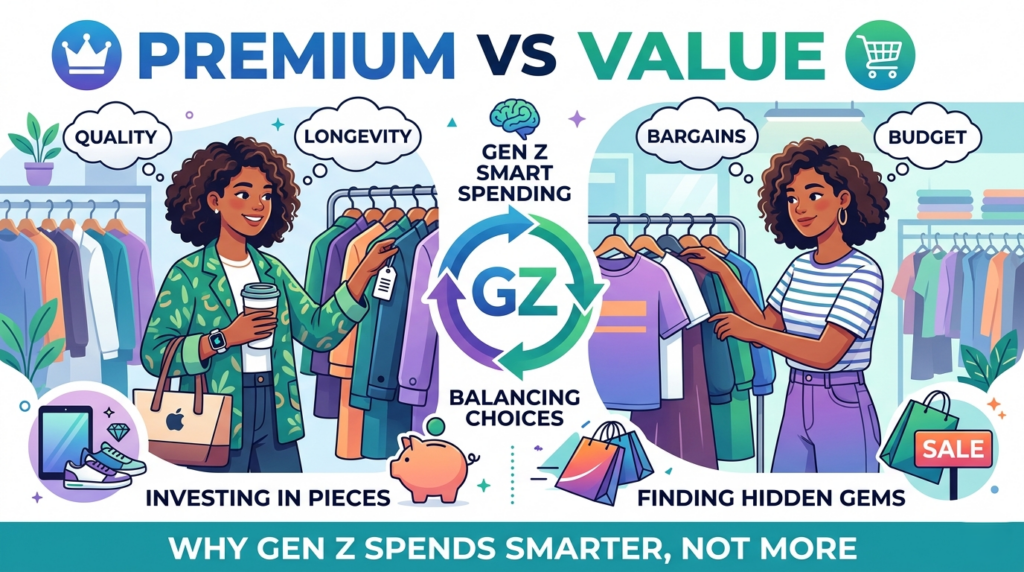
Short answer: Gen Z isn’t a reckless spender. They’re an intentional one. A 2023 Capgemini report found a significant share actively assess quality, durability and relevance before they buy. Nielsen consistently shows peer recommendations rank among the most trusted forms of influence worldwide. The new fight isn’t premium vs value. It’s perceived worth vs perceived waste.
For years Gen Z has been cast in one familiar light. Impulsive, trend-chasing, financially careless. Scroll through any feed and the stereotype seems to confirm itself: viral hauls, influencer pushes, the constant buzz of quick commerce.
That’s only half the story. Look closer and a more layered pattern emerges. Beneath the surface-level consumption sits a generation that thinks unusually hard about how, where and why it spends. Gen Z isn’t spending more, they’re spending smarter, and in doing so they are quietly redefining what “premium” and “value” mean.
Is Gen Z really a careless spender?
At first glance, sure, Gen Z looks like it’s in a permanent state of consumption. New sneakers, trending gadgets, curated wardrobes. Easy to assume excess. But that read is misleading.
Much of what looks like impulse is informed decision-making happening behind the scenes. Before clicking “buy”, many young consumers have already compared alternatives, checked reviews, watched YouTuber breakdowns and weighed long-term utility. According to a 2023 report by Capgemini, a significant share of Gen Z consumers actively assess quality, durability and relevance before purchasing. Impulse still exists, but it’s rarely blind. It’s calculated.
How did financial awareness shape this generation?
To understand the mindset, you have to look at the environment they grew up in. This is a generation that watched economic uncertainty and job volatility from up close, dealt with rising living costs and constant student-debt conversations, and saw financial knowledge get democratised online almost overnight.
Unlike previous generations, Gen Z didn’t just grow up consuming. They grew up observing consumption critically. Budgeting apps, finance influencers, comparison tools, the lot. Information is everywhere, and access to it changes behaviour. They don’t just ask “can I afford this?” They ask “is this worth it?” Subtle shift, big consequence.
Why is the premium-vs-value binary broken?
Brands have long leaned on a clean equation. Premium = expensive and aspirational. Value = affordable and accessible. Gen Z doesn’t buy into that binary.
For them the relationship between price and value is far more fluid. A Rs 500 product can feel premium if it delivers meaning, reliability or identity, and a Rs 50,000 purchase can feel wasteful if it lacks relevance. Value isn’t defined by price. Premium isn’t defined by cost. That redefinition forces brands to rethink positioning from the ground up.
What does “value” actually mean to Gen Z?
Utility and longevity
Functionality matters, but so does durability. Gen Z is less interested in short-term gratification and more focused on whether a product will stand the test of time. Whether it’s clothing, electronics or even subscriptions, the question often is “will this still feel useful months from now?” That emphasis on longevity turns a purchase into an investment.
Emotional and cultural relevance
Products today are more than functional objects, they’re expressions of identity. A sneaker isn’t just footwear. A phone isn’t just a device. A brand isn’t just a company. They’re signals.
Gen Z gravitates toward brands that align with their beliefs, aesthetics and personality, which is why storytelling, cultural relevance and purpose-driven branding often outperform cheaper alternatives. People don’t just buy what works. They buy what resonates.
Social proof as currency
In an era of information overload, trust gets critical. Before pulling the trigger, Gen Z often seeks validation from reviews and ratings, social media comments, creator opinions and online communities. Research by Nielsen consistently shows peer recommendations rank among the most trusted forms of influence worldwide. A product validated by real users carries more weight than the most polished ad.
Experience over ownership
Another defining shift: from accumulation to experience. Gen Z is increasingly willing to spend on events and travel, limited-edition drops and cultural moments. Instead of asking “what do I own?”, they ask “what did I experience?” This doesn’t mean they reject products. It means they value products that create or enhance experiences.
Why doesn’t “cheap” win anymore?
There was a time when the lowest price guaranteed attention and conversion. That time is fading. Today, “cheap” often signals compromise — lower quality, lack of authenticity, disposable value. Gen Z is highly perceptive. They spot shortcuts quickly, and they rarely reward them.
Many adopt a counterintuitive approach instead. Spend less frequently, spend more thoughtfully, choose meaning over volume. It’s not about frugality. It’s about intentionality.
What does conscious spending look like in practice?
One of the most interesting patterns in Gen Z behaviour is what you could call conscious spending. It doesn’t mean avoiding purchases. It means prioritising them carefully.
A typical pattern? Cut back on everyday indulgences, save in low-priority areas, splurge on items that truly matter. Someone might hesitate to spend Rs 300 on food delivery but willingly drop Rs 3,000 on a concert ticket or a pair of sneakers they’ve researched extensively. At first glance that looks inconsistent. It’s not. It’s strategic.
The trade-off mindset
I’ve noticed this in conversations with friends and even in my own habits. There’s a long pause before small habitual expenses, subscriptions, convenience purchases, impulse orders, but when something genuinely meaningful shows up, the hesitation vanishes.
A friend in Mumbai spent two weeks debating whether to renew a streaming service that costs Rs 149 a month. The day a limited-edition drop landed from a brand he’d been tracking, he checked out in under a minute. That contrast isn’t irrational. It reflects a deeper truth. Gen Z doesn’t spend randomly, they spend with intent.
Where do brands misread the shift?
Despite obvious signals, plenty of brands still lean on outdated playbooks.
Competing only on price
Lowering prices might pull attention, but it doesn’t build preference. In some cases, it actively erodes perceived quality.
Overusing “premium” as a label
Just being expensive no longer guarantees desirability. Without substance, premium positioning feels hollow, almost performative.
Ignoring context
Value isn’t created in isolation. It’s shaped by cultural relevance, timing and community perception. A product’s success depends as much on its context as on its features.
What are smart brands doing differently?
Building meaning, not just products
Successful brands invest in storytelling, purpose and cultural alignment. They give consumers a reason to care.
Justifying the price
Transparency is becoming a competitive advantage. Brands that explain why something costs what it does build trust and credibility.
Creating scarcity and experience
Limited drops, collaborations and experiential marketing make products feel special and worth investing in.
Leveraging community validation
Instead of controlling the narrative, smart brands amplify their communities. Reviews, user-generated content and creator partnerships become key trust signals. Because ultimately, people trust people more than brands.
Why does spending feel like identity now?
For Gen Z, spending isn’t just a transaction. It’s a form of self-expression. Every purchase answers a deeper question: “Does this represent who I am?”
That’s why generic products struggle to stand out, cultural brands gain traction and story-driven marketing performs better. Spending becomes less about utility alone and more about identity.
Spending right beats spending more
Gen Z is not rejecting consumption. They’re refining it. They don’t chase the cheapest option, and they don’t blindly follow the most expensive brand. Instead they choose what feels worth it, relevant and meaningful. This shift challenges traditional marketing assumptions and forces brands to rethink strategy from the ground up.
Because in the end, the real competition isn’t between premium and value. It’s between perceived worth and perceived waste.
FAQs about Gen Z conscious spending
Is Gen Z actually careful with money?
Yes, more careful than the stereotype suggests. A 2023 Capgemini report found a significant share of Gen Z consumers actively assess quality, durability and relevance before purchases. Their impulse buys are usually researched first, even if it doesn’t look that way from the outside.
What does conscious spending mean for Gen Z?
Conscious spending means cutting back on low-priority expenses to free up budget for purchases that truly matter. A typical Gen Z buyer might skip Rs 300 food delivery but spend Rs 3,000 on a concert ticket or a researched pair of sneakers, because the second one delivers meaningful experience or identity.
Why doesn’t a low price always win with Gen Z?
Because cheap often signals compromise — lower quality, lack of authenticity and disposable value. Gen Z is highly perceptive and rarely rewards shortcuts. They tend to spend less frequently but more thoughtfully, choosing meaning over volume.
What do Capgemini and Nielsen say about Gen Z buying habits?
Capgemini’s 2023 report shows Gen Z evaluates quality, durability and relevance before buying. Nielsen consistently finds peer recommendations are among the most trusted forms of influence worldwide, which is why reviews, creator opinions and community validation drive Gen Z purchase decisions.
How should brands win with Gen Z?
Build meaning, not just products. Justify pricing with transparency, create scarcity and experience, and amplify community validation rather than controlling the narrative. Premium and value are both outdated framings — focus on perceived worth instead.