Short answer: If YouTube went silent tomorrow, thousands of Indian creators would lose their primary income overnight, engineers would scramble in crisis mode, and Gen Z would feel the disconnect in their daily routines. Users already spend over 45 minutes daily on the platform, per a 2023 Statista report, making a shutdown less a glitch and more an economic and cultural jolt.
What would it feel like if YouTube stopped loading?
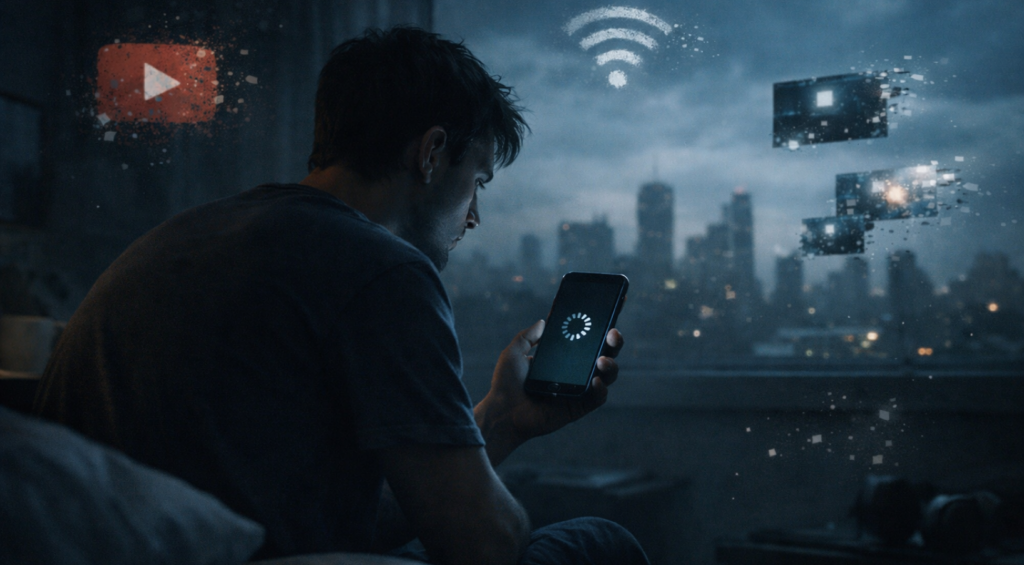
Imagine waking up, reaching for your phone, and opening YouTube, only to find it stuck on an endless loading screen. No music to ease you into the morning. No quick tutorials. No comforting background noise. Just silence.
At first, it feels like a minor glitch. You refresh. You wait. You try again. Slowly, a heavier realization sets in: what if this isn’t temporary?
We often think of YouTube as another app. In reality, it has become part of our muscle memory. For many of us, opening it isn’t a decision, it’s instinct. A 2023 report by Statista revealed that users spend an average of over 45 minutes daily on the platform. That’s habit, even dependence.
Why is YouTube a hidden economy, not just entertainment?
Behind the familiar interface sits a massive economic engine. YouTube fuels billions of dollars through ads, subscriptions, and creator ecosystems. More importantly, it sustains livelihoods.

In India alone, thousands of creators rely on YouTube as their primary income source. Daily vloggers, educators, gamers, and musicians have built entire careers on this platform. If YouTube stopped functioning for a day, income streams would freeze. Rent payments, EMIs, and brand collaborations would stall.
A small YouTube educator once told me, “One bad week on YouTube feels like a financial earthquake.” That statement stuck with me. Platforms aren’t digital spaces alone, they’re economic lifelines.
What happens behind the scenes during a YouTube outage?
Shift your perspective. It’s 4 a.m., and somewhere in the world, an engineer’s phone rings. A single message flashes: “YouTube is down.”

While billions of users refresh their screens in frustration, a handful of engineers enter crisis mode. No applause, no recognition, only pressure. The internet, often perceived as magical and smooth, is actually held together by human effort, sleepless nights, and complex systems operating at unimaginable scale.
Technology doesn’t fail gracefully. It stumbles, sometimes chaotically.
Why does trust matter more than revenue when YouTube fails?
If YouTube goes down, the immediate loss is obvious: views, engagement, and revenue. The deeper damage is less visible: trust.
Markets don’t panic over temporary setbacks; they panic over uncertainty. If a giant like Google can experience a failure, it raises uncomfortable questions. What else is vulnerable? How fragile are the systems we rely on daily?
Investors understand this well. According to financial analysts, stock prices are often more sensitive to doubt than to actual losses. A single disruption can ripple across markets, not because of what happened, but because of what might happen next.
What if the entire internet disappeared, not just YouTube?
Take it one step further. What if it’s not just YouTube, but the entire internet?
No Wi-Fi. No mobile data. No messages. No maps. No payments.
At that moment, modern life doesn’t slow down, it pauses.
The internet isn’t a tool anymore; it’s infrastructure, as essential as electricity or roads. Unlike power outages where backups often exist, most of us have no contingency plan for a disconnected world.
Think about your last 24 hours. Ordering food, making payments, attending meetings, navigating routes, all online. Without the internet, even simple tasks become complicated. Airports slow, banks freeze, hospitals struggle, and businesses bleed revenue.
How would Gen Z cope without constant connection?
For Gen Z, the impact runs deeper. No social media. No streaming. No instant communication. The silence isn’t boring, it’s unsettling.

We’ve built our routines, relationships, and identities online. In doing so, we’ve optimized for speed and convenience, not resilience. When the connection drops, so does a part of our daily rhythm.
I’ve lived through brief internet outages that felt oddly disorienting. Not because I couldn’t work, but because I didn’t know what to do with the sudden stillness. That’s when it hits: you’re not just disconnected from the internet, you’re disconnected from your routine.
Why do we ignore the fragility of tech we depend on?
We often debate futuristic concerns like AI taking over jobs or robots replacing humans. Yet we rarely question the foundation everything else stands on.
The uncomfortable truth: the systems we trust the most are often the ones we understand the least.
Technology hasn’t just made life easier; it has quietly taken control of our habits, attention, and emotional comfort. And while it feels permanent, it isn’t invincible.
A question worth asking
So what happens if YouTube, or the internet, stops working tomorrow?
Would you miss the music? A favourite creator? Or the comfort of constant noise?
More importantly, what would break first: your work, your routine, or your sense of calm?
In a world built on connection, silence isn’t empty. It’s revealing.
FAQs about a YouTube or internet shutdown
How long can YouTube survive a full outage before creators lose income?
Creator income depends on daily views, ad impressions, and brand deals tied to content calendars. Even a 24-hour outage halts ad revenue and can delay brand payments, and some educators describe a bad week on YouTube as a financial earthquake.
How much time does the average user spend on YouTube every day?
A 2023 Statista report found users spend an average of over 45 minutes daily on YouTube. For many Indians, the platform is a first-thing-in-the-morning habit rather than casual entertainment.
Why does a YouTube outage affect Google’s stock price?
Financial analysts note that stock prices react more to uncertainty than to a single day of lost revenue. An outage at a company as large as Google makes investors question the reliability of the broader digital stack, which moves the market.
What would stop working first if the whole internet went down in India?
UPI payments, Google Maps, food delivery apps, office meeting tools, and messaging services would freeze almost instantly. Airports, banks, and hospitals depend on connected systems, so operational chaos would follow within hours.
Why is Gen Z more affected by digital blackouts than older generations?
Gen Z has built friendships, creative careers, and daily routines on social media, streaming, and instant messaging. Without those, the disruption is emotional and structural, not just a missed notification.