
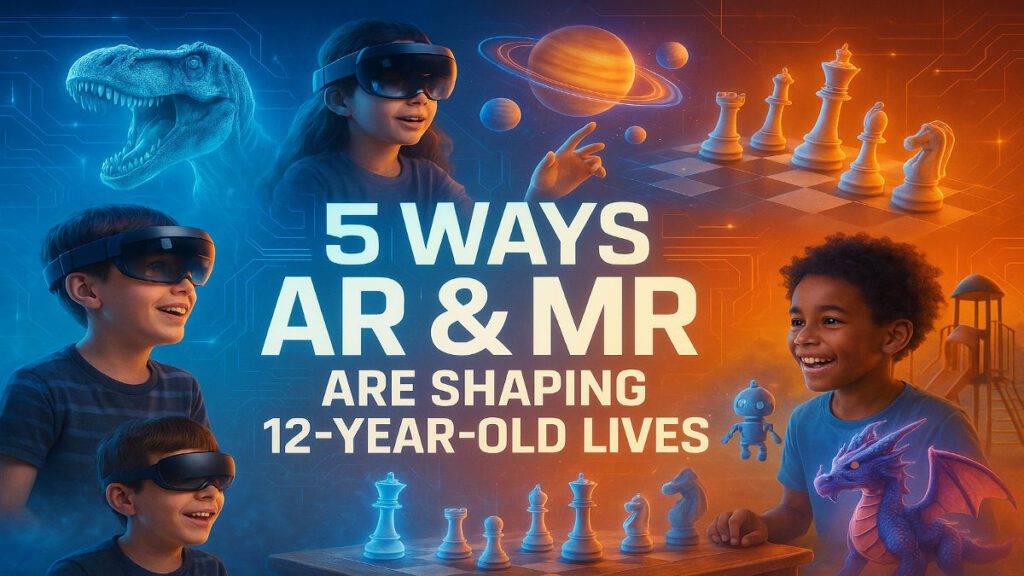
Short answer: For 12-year-olds in 2025, AR and MR are changing how they learn, play, socialise and build future skills. Augmented Reality overlays digital content on the real world, while Mixed Reality lets kids interact with those digital objects, turning classrooms, backyards and living rooms into blended play and study spaces.
For a 12-year-old in 2025, technology doesn’t feel like a tool. It feels like an extension of their world. Augmented Reality (AR) and Mixed Reality (MR) aren’t buzzwords for them. They are part of how Gen Alpha kids learn, play, connect and imagine. This is the first generation growing up where virtual objects not only appear in their real-world space but also respond to it.
What does that mean for a pre-teen in today’s hyper-connected landscape? Here are five powerful ways AR and MR are shaping the lives of 12-year-olds in 2025.
1. How are digital and physical worlds blending for Gen Alpha?
Imagine a world where your living room becomes a jungle and your school desk turns into a volcano lab. For today’s 12-year-olds, that isn’t fantasy. It’s Tuesday.
Augmented Reality overlays digital images, animations and text onto the physical environment. Kids use it to:
- Bring textbooks to life with 3D planets, moving dinosaurs and animated math problems.
- Play games like Pokémon GO, where virtual creatures roam their real neighbourhoods.
- Try on clothes or decorate a virtual room, mixing creativity with real-world decision-making.
Mixed Reality goes further. It anchors digital objects in the real world so kids can interact with them, like building Lego castles in thin air or moving virtual chess pieces across their kitchen table.
“When I use my headset, it’s like my room turns into a spaceship,” says Aarav, a 12-year-old from Bengaluru. “And I’m the captain.”
2. How does AR and MR make education an adventure?
Forget static textbook images. Today’s AR and MR apps turn learning into an interactive journey.
Students can:
- Dissect a frog without touching one.
- Watch historical events unfold in their living room.
- Explore outer space or dive into the human body in 3D.
These technologies are powerful in subjects like science, geography and history, where seeing is often understanding. According to educators using platforms like Merge EDU and zSpace, students retain more when they engage with content physically and visually.
A study by the University of Maryland found that students using AR-based simulations scored 33% higher on comprehension tests than those learning through traditional methods.
3. How has AR and MR upgraded playtime?
Gaming has always captured kids’ imagination, but with AR and MR, play is more active, immersive and social.
Whether it’s battling dragons in your backyard, solving puzzles that require real-world movement, or designing your own digital city, 12-year-olds are no longer passive players. They are creators in their own alternate realities.
AR filters on platforms like Snapchat and Instagram also let kids express themselves creatively, from animated animal faces to voice-changing masks. It is entertainment and self-expression rolled into one dynamic experience.
4. How is AR and MR changing how kids socialise?
Social interaction in 2025 is location-based, interactive and sometimes 3D.
Using MR headsets or shared AR spaces, friends can:
- Collaborate on group art projects from different cities.
- Explore virtual museums together.
- Compete in shared games that unfold across real-world spaces.
Unlike earlier generations who mostly texted or called, Gen Alpha kids meet in digital layers over the real world, often combining outdoor exploration with virtual discovery.
“My friends and I built a castle on the playground — but it only shows up through our glasses,” shares Ananya, a seventh grader from Pune.
5. What future skills do AR and MR build in 12-year-olds?
While it may look like play, AR and MR are also skill-building machines.
Through immersive interaction, 12-year-olds are developing:
- Critical thinking and spatial reasoning, as they manipulate 3D environments.
- Problem-solving, when puzzles demand real-world movement or coordination.
- Digital creativity, especially when designing custom AR filters or virtual models.
These experiences are preparing them for the metaverse, a shared digital universe already taking shape. By the time they hit high school, today’s 12-year-olds may be attending virtual campuses, working digital jobs, or building virtual economies.
A new kind of childhood
In 2025, AR and MR aren’t novelties. They are the norm for Gen Alpha. For a 12-year-old, tech isn’t separate from life. It is life. It’s their classroom, playground, creative studio and hangout spot.
It’s up to parents, educators and technologists to guide this shift with care so that immersive doesn’t become isolating, and so wonder leads to wisdom.
Because while their worlds may be mixed and augmented, their dreams are very, very real.
FAQs about AR and MR for kids
What is the difference between AR and MR?
AR overlays digital images, animations or text onto the real world. MR goes further and anchors those digital objects in the real environment so kids can interact with them in real time.
Which AR and MR apps are popular with 12-year-olds?
Popular picks include Pokémon GO for outdoor play, Snapchat and Instagram AR filters for self-expression, and classroom platforms like Merge EDU and zSpace for immersive lessons.
Does AR actually help kids learn better?
A study by the University of Maryland found students using AR-based simulations scored 33% higher on comprehension tests than those using traditional methods, with the biggest gains in science, geography and history.
Is AR and MR safe for 12-year-olds?
AR and MR are broadly safe when parents and educators supervise screen time, balance indoor and outdoor use, and keep social features age-appropriate so immersive play doesn’t turn isolating.
How do AR and MR prepare kids for the metaverse?
By getting used to 3D environments, spatial interaction and digital creativity early, Gen Alpha kids are learning the core skills they will need for virtual campuses, digital jobs and online economies.