
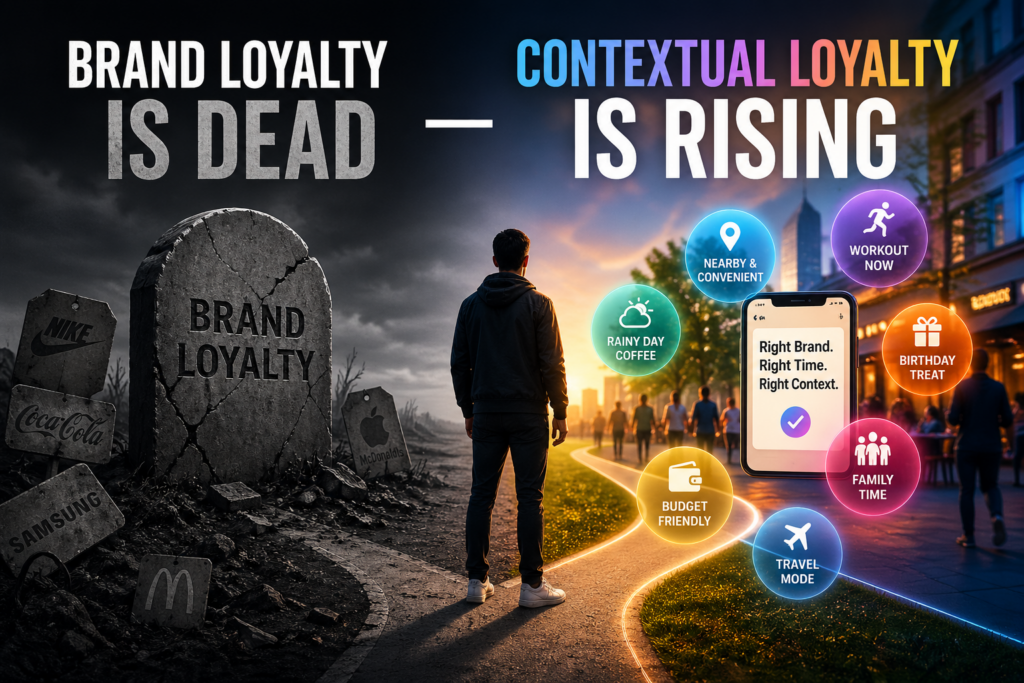
Short answer: Brand loyalty hasn’t died. It’s evolved into contextual loyalty, where Gen Z picks the brand that fits the moment. McKinsey notes that modern consumers experiment more thanks to lower switching costs, and Nielsen finds younger shoppers far more open to new brands. Win the moment with relevance, not a rewards card.
For decades, marketing leaned on a comforting story. Build a great product, build a strong brand, and customers will stick around. Repeat purchases were read as proof of emotional connection. Familiarity was assumed to translate into commitment. Loyalty programs, reward points, brand communities. All of it sat on this one belief.
Then something shifted. Quietly, almost imperceptibly, Gen Z rewrote the rules. They don’t stick to one brand, they switch, frequently and without guilt. And the part that throws older marketers off: they’re not being disloyal. They’re being contextual.
Is Gen Z really not loyal?
At first glance, sure, Gen Z looks like a generation with no allegiance. One day it’s Zara, the next it’s Zudio, and sometimes a thrift haul or a street-market kurta from Sarojini. To traditional marketers, this reads as inconsistency. It isn’t.
It’s a behaviour shift where loyalty has gone from fixed to fluid. Gen Z doesn’t ask “which brand do I love?” They ask “what works for me right now?” And honestly, that one rephrasing changes the whole game.
What is contextual loyalty?
Contextual loyalty isn’t long-term commitment to a single brand. It’s making choices based on situation, mood, social setting and immediate need. Loyalty is no longer brand-centric. It’s moment-centric.
A typical Gen Z consumer might pick Zara for a formal event, grab Zudio for casual everyday wear and dive into thrift stores when they want unique, expressive pieces. Each choice is intentional, each one makes sense in its context. This isn’t random behaviour. It’s adaptive decision-making, and frankly the smartest people I know shop exactly this way.
Why is this shift happening?
Infinite choice has killed friction
The digital ecosystem has fundamentally changed how consumers interact with brands. With Amazon and Flipkart, switching is effortless. No need to visit multiple stores, no reliance on limited inventory, no long decision cycles. Everything is available, instantly. According to a McKinsey & Company report, modern consumers are more likely to experiment with new brands due to increased accessibility and reduced switching costs. When switching becomes easy, sticking becomes optional.
Identity is fluid now
Earlier generations built stable identities over time. Gen Z runs differently, their identity shifts based on mood, platform (Instagram vs LinkedIn is practically two different humans), social environment and personal evolution. Their consumption patterns mirror that fluidity. A single brand cannot represent every version of who they are, so they choose differently depending on who they are in that moment.
Discovery never stops
Gen Z doesn’t just consume. They explore. Social platforms keep introducing them to new brands, emerging creators and niche communities. The result? A constant cycle of discovery. Research from Nielsen highlights that younger consumers are significantly more open to trying new brands than older generations, and that openness chips away at dependence on any single label.
How does the Swiggy-vs-Zomato switch actually look?
Take something as ordinary as food delivery. A Gen Z consumer might order from Swiggy on Monday and switch to Zomato on Wednesday. Not because they’ve changed sides forever, but because in that moment one had a better offer, one had faster delivery, or one simply felt more convenient that night.
The decision is contextual, not emotional. And this pattern repeats across categories. Fashion, tech, entertainment and beyond.
What’s the psychology behind these choices?
At its core, contextual loyalty is driven by a shift in how consumers evaluate value. Instead of asking “do I like this brand?”, they ask:
- “Does this fit my current need?”
- “Does this match my mood?”
- “Does this feel right right now?”
This moment-based evaluation makes decisions faster and far more flexible. It also makes loyalty dynamic rather than static.
What do brands keep getting wrong?
Despite obvious signals, plenty of brands still operate on outdated assumptions.
Expecting long-term loyalty without evolving. Brands assume past engagement guarantees future commitment, but in a contextual world relevance has to be re-earned, again and again.
Mistaking repeat purchase for emotional connection. A customer buying again doesn’t mean they’re loyal, it might just mean the brand fit the context that one time.
Ignoring changing user contexts. Consumers don’t exist in a single state. They move between roles, moods and environments. Brands that don’t adapt to those shifts quietly slide into irrelevance.
The “depends” generation
I’ve noticed this in conversations more often than I expected. Last month I asked a group of college students in Bangalore which brand they preferred for sneakers, and the answer was rarely absolute. It was almost always “it depends.” Depends on the occasion, depends on the budget, depends on the mood. That word, depends, perfectly captures the essence of contextual loyalty. It isn’t indecision. It’s intentional flexibility.
What are smart brands doing differently?
Staying present everywhere
Instead of relying on one channel, smart brands keep visibility across platforms — social media, marketplaces, offline stores and the rest. Different contexts need different entry points.
Adapting messaging on the fly
The same brand doesn’t speak the same way in every situation. It tunes tone, content and communication based on platform, audience mindset and usage context. That adaptability keeps the brand relevant, which is the only currency that matters now.
Building familiarity, not forced loyalty
Smart brands have realised loyalty cannot be demanded. It has to be earned, repeatedly. So they focus on consistent presence, recognisable identity and positive experiences. Over time this builds familiarity, and familiarity raises the odds of being picked again. And again.
How are Indian brands navigating this?
India offers strong examples of brands adapting to contextual loyalty. Take Reliance Trends and Zudio. Both serve similar audiences but are chosen differently depending on occasion and need. In quick commerce, Blinkit coexists with Swiggy Instamart, and consumers don’t commit to one, they choose based on urgency, availability and convenience. This isn’t pure competition. It’s contextual coexistence, which is a whole different beast.
Why is access replacing ownership?
Step back and the bigger trend gets clearer. Consumers today value access over ownership. They don’t need to “belong” to a brand. They need the brand to be available when required, period. This mindset trims exclusivity but expands flexibility, and flexibility is what defines modern consumption.
Is loyalty really dead?
It’s tempting to declare brand loyalty dead. But that’s not entirely true. Loyalty hasn’t disappeared, it has transformed. It’s no longer long-term commitment to a single brand, it’s repeated alignment with the right context.
Gen Z is loyal. Just not in the way brands expect. They’re loyal to experiences that feel right, products that deliver in the moment and brands that keep showing up as relevant. Win the moment, you win the customer. Miss it, and they move on.
FAQs about contextual loyalty
What is contextual loyalty?
Contextual loyalty is the modern pattern where consumers, especially Gen Z, choose brands based on the immediate situation, mood and need rather than long-term commitment. The same person might pick a premium brand for one occasion and a value brand for another, and both choices are intentional.
Why does Gen Z switch between brands like Zara and Zudio?
Because their identity itself is fluid. A formal event calls for Zara, casual everyday wear suits Zudio, and a thrift store fits when they want self-expression. Each pick is contextual, not a sign of disloyalty.
What do McKinsey and Nielsen say about brand switching?
McKinsey reports that modern consumers experiment more thanks to easier access and lower switching costs. Nielsen finds younger consumers significantly more open to trying new brands than older generations, both of which support the rise of moment-based loyalty.
How can brands win in a contextual loyalty world?
Stay present across multiple touchpoints, adapt tone and messaging by platform and context, and focus on building familiarity rather than demanding loyalty. The goal is to be the obvious choice in the moment, not the only choice forever.
Is brand loyalty completely dead?
No. Loyalty has evolved, not vanished. Consumers are still loyal, but to experiences that feel right and brands that stay relevant across changing contexts, rather than to a single name on a label.