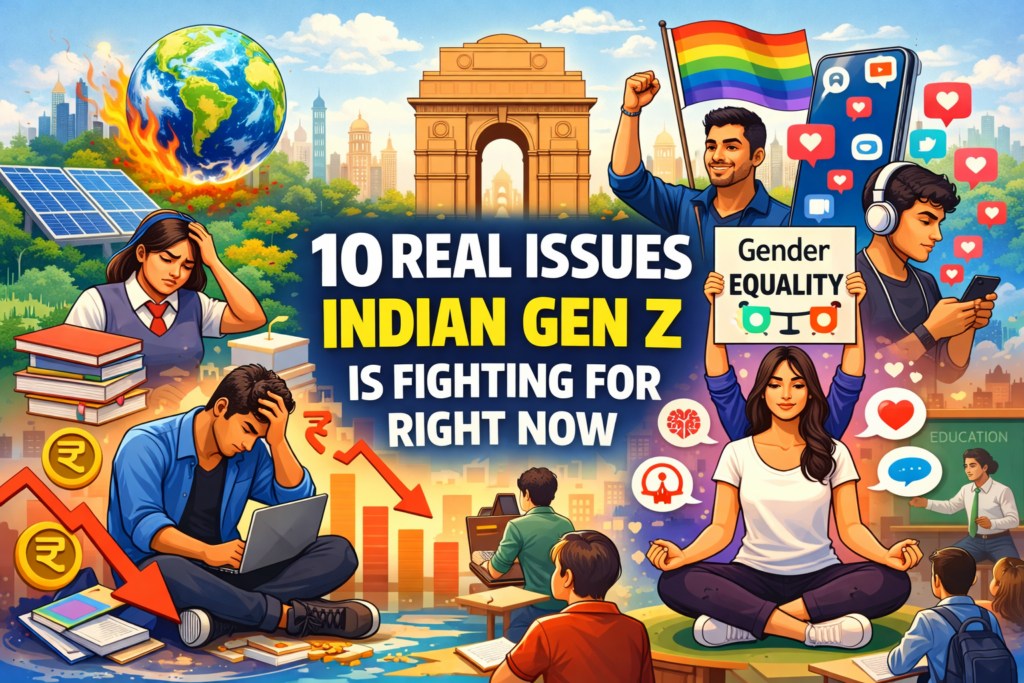
Short answer: Indian Gen Z cares most about climate change, mental health, careers and money, education, gender equality, social media, health and wellness, identity and inclusion, safety, and AI. The Youth Talks spoke with over 100 young Indians across cities like Indore and Jaipur, and their voices, combined with Deloitte and Forbes reports, show a generation that cares with urgency.
Is Indian Gen Z really disengaged?
Spend a few minutes in a college canteen in Indore, scroll Instagram in Jaipur, or sit quietly in a Delhi metro, and you’ll notice something subtle but powerful. Gen Z is not disengaged.
They may laugh at memes and switch trends fast, but beneath that lies a deeply aware, socially conscious mindset. They ask questions, challenge norms, and are paying attention.
The Youth Talks spoke with over 100 Gen Z individuals across India, including cities like Indore and Jaipur. Their responses, paired with insights from Deloitte and Forbes reports, reveal a striking truth: this generation doesn’t just care, they care with urgency.
Why is climate change a daily issue for Gen Z?
For Gen Z, climate change is not a textbook chapter. It is lived reality.

Rising temperatures, unpredictable weather and pollution are daily experiences, not abstractions. According to global and Indian surveys, a large majority of Gen Z expresses concern about climate change, with many actively trying to reduce their environmental footprint.
A 19-year-old student from Jaipur shared, “We’re not talking about 2050. We’re talking about what’s happening right now. Summers feel harsher. Air feels heavier.”
From thrifted fashion to sustainable brands, Gen Z is aligning consumption with conscience.
How is Gen Z changing the mental health conversation?
One defining shift is how openly Gen Z talks about mental health. Stress, anxiety and burnout, once hidden, are part of everyday conversations.
A student from Indore told us, “We check in on our friends emotionally now. It’s not just ‘what are you doing?’ but also ‘are you okay?'”
Reports suggest workplace stress, academic pressure and social media exposure contribute to mental health struggles. The silver lining is awareness: therapy is being normalised, and vulnerability is no longer seen as weakness.
Why do careers and money feel heavier for Gen Z?
Behind every “living my best life” post lies a quiet anxiety: what about the future? Financial stability is a major concern for Indian Gen Z. Surveys show nearly half of young adults feel uncertain about their financial future.
A 24-year-old working professional from Delhi said, “There’s pressure to follow your passion and also make money. Sometimes it feels like you have to choose.”
This tension has driven side hustles, freelancing and skill-based learning. Degrees alone aren’t enough. Gen Z wants security, but not at the cost of purpose.
Is the Indian education system outdated for Gen Z?
For a generation that learns coding on YouTube and marketing through Instagram, classroom learning often feels restrictive.

A Jaipur-based student remarked, “We memorise things for exams and forget them right after. That can’t be the goal of education.”
Reports indicate education and skill gaps rank among Indian Gen Z’s top concerns. They are not rejecting education. They are redefining it.
Why is gender equality non-negotiable for Gen Z?
For Gen Z, equality isn’t aspirational. It is expected. From workplace bias to safety for women, the issue remains rooted, but the response has changed.
A 22-year-old student from Indore shared, “Our mothers adjusted. We don’t want to. That’s the difference.”
Gen Z is more vocal and less tolerant of inequality. Conversations around pay gaps, representation and safety are getting louder and harder to ignore.
Does Gen Z see social media as connection or comparison?
Gen Z lives online, but is increasingly aware of the downsides.

Social media offers connection, creativity and opportunity, alongside comparison, anxiety and unrealistic standards.
A Delhi-based student said, “I know social media affects my mood, but it’s also where everything happens. You can’t just disconnect.”
Many Gen Z users are now experimenting with digital detoxes and setting boundaries, a sign of growing self-awareness.
How does Gen Z approach health and wellness?
Health, for Gen Z, is no longer reactive. It is proactive. From fitness apps to sleep tracking, young adults are taking control of their well-being.
A student from Jaipur shared, “I track my steps, water intake, even my sleep. It makes me feel more in control.”
According to surveys, healthcare and preventive awareness rank among key concerns for Gen Z. It is not only about living longer. It is about living better.
Why is identity and inclusion central to Gen Z?
Gen Z is redefining identity in India.

They are more open to conversations around gender, sexuality and individuality, and are creating spaces where people can express themselves without fear.
An Indore-based respondent put it simply, “We just want to exist as we are. Without labels or judgment.” This push for authenticity is reshaping social norms slowly, but surely.
How serious is safety as a Gen Z concern?
Safety remains a pressing concern, particularly in urban environments. Whether it is late-night travel or navigating public spaces, many Gen Z individuals, especially women, factor safety into daily decisions.
This isn’t a statistic. It is an experience. And Gen Z is increasingly vocal about demanding safer environments and better systems.
Does Gen Z see AI as opportunity or threat?
AI is exciting and unsettling for Gen Z. It offers new career paths while raising questions about job security.

A tech student from Delhi said, “AI can do so much. But sometimes I wonder, where do we fit in?”
Reports suggest a large percentage of Gen Z sees AI as beneficial, while many also worry about its long-term impact on employment. It’s a relationship defined by curiosity and caution.
What does the bigger picture say about this generation?
When you step back, a pattern emerges. Gen Z in India cares about:
- The environment
- Mental well-being
- Financial security
- Equality and inclusion
- The future of work
They are not passive observers of society. They are active participants, and often the ones initiating conversations others hesitate to start.
Expectation, not aspiration
What sets Gen Z apart is not just what they care about, but how they approach it. They don’t wait for change. They question systems. They challenge outdated norms. And they expect better, from institutions, from brands, and from society itself.
For anyone trying to understand or engage with this generation, the message is clear: you can’t just talk to Gen Z. You have to listen.
FAQs about Indian Gen Z and the issues they care about
What are the biggest issues for Indian Gen Z right now?
Climate change, mental health, careers and money, education reform, gender equality, social media wellbeing, preventive health, identity and inclusion, safety, and AI. The Youth Talks mapped these by speaking to over 100 young Indians across cities like Indore and Jaipur.
How does Gen Z in India view mental health?
Gen Z treats mental health as an everyday topic, not a taboo. Students say they check in emotionally with friends, normalise therapy, and see vulnerability as strength rather than weakness.
Is Indian Gen Z optimistic about careers and money?
They are cautious. Surveys cited in this piece show nearly half of young Indian adults feel uncertain about their financial future, which is driving the rise of side hustles, freelancing and skill-based learning alongside full-time jobs.
What does Gen Z want from the education system?
They want learning that is relevant, skill-based and less dependent on memorisation. Reports mentioned here show education and skill gaps among the top concerns, and Gen Z prefers platforms like YouTube and Instagram for practical learning.
Is Gen Z worried about AI taking their jobs?
Many Gen Z users see AI as beneficial but also worry about its long-term impact on employment. As one Delhi tech student put it, “AI can do so much. But sometimes I wonder, where do we fit in?”