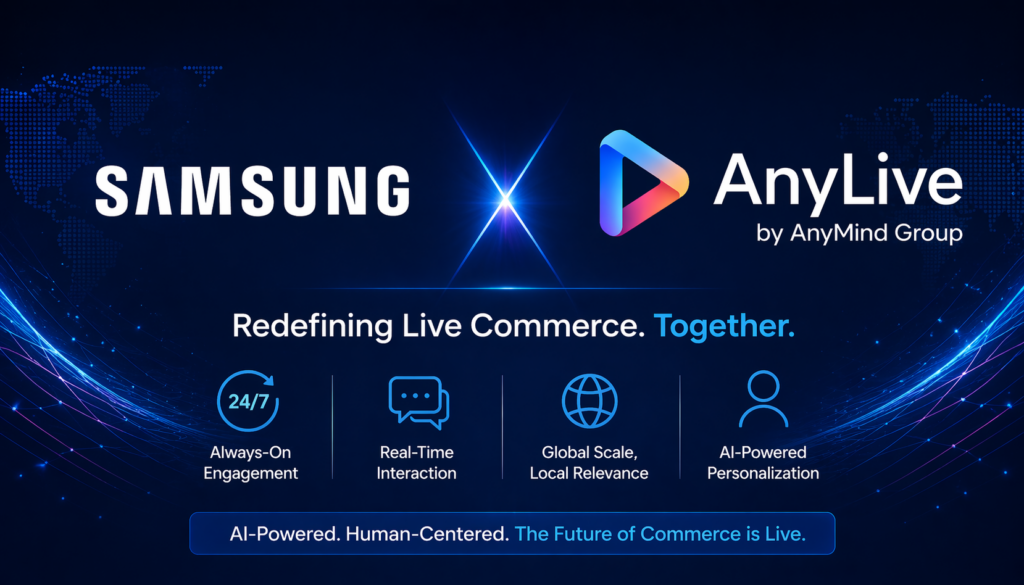
Short answer: Samsung Electronics has partnered with AnyMind Group to roll out AI-powered live commerce through AnyLive across eight markets and thousands of livestream hours. The bigger story isn’t just live commerce, it’s Samsung rebuilding commerce around always-on, AI-led, internet-native behaviour. Gen Z is the signal here, not the cause.
And Gen Z is simply the first cohort to fully embody it
The story of commerce has always evolved alongside human behaviour. From local markets to organised retail to e-commerce, each shift has been driven not by technology alone but by how people choose to discover, evaluate and purchase products. Today, we’re at another inflection point.
With its latest move, Samsung Electronics has partnered with AnyMind Group to deploy AI-powered live commerce through AnyLive across multiple global markets. On the surface this looks like a continuation of the live commerce trend. It’s actually something more fundamental. Samsung isn’t only scaling live commerce. It’s rebuilding commerce itself, around internet-native behaviour. And while Gen Z is often framed as the focal point of such shifts, the more accurate lens is this: Gen Z is simply the first cohort to fully embody behaviours that are rapidly becoming universal.
How did commerce go from fixed to fluid?
Traditional commerce was built around constraints. Fixed store hours, geographic limits, human-led interactions, scheduled broadcasts. Even early e-commerce kept many of these characteristics in digital form, structured, predictable and largely transactional.
Consumer behaviour has outgrown those systems. Today people don’t “enter” commerce environments deliberately. They discover products while scrolling content, interact in real time through comments and chats, expect instant responses and engage at any hour of the day. Commerce has become continuous, embedded within digital life rather than separate from it. That’s the foundation of internet-native behaviour.
Why is Samsung going always-on?
One of the clearest signals of Samsung’s strategic shift is its move toward an always-on engagement model. Through AnyLive, the company is adding thousands of livestream hours each month, powered by both human hosts and AI avatars. That dramatically changes the nature of retail engagement.
Chang Soo Park, Regional Head of Online Business, Samsung Electronics Southeast Asia and Oceania, captured this transition clearly:
“We’re now in a pivotal moment in how we connect with our customers, moving beyond the limitations of traditional broadcast schedules to an ‘Always-On’ engagement model. With live commerce partners, such as AnyLive, we are ensuring that every consumer, regardless of their time zone or schedule, can experience personalized, interactive and high-quality demonstration of our product ecosystem through AI innovation and real-time commerce.”
This isn’t just about increasing output. It’s about eliminating downtime as a concept in commerce. In an internet-native world there is no “opening” or “closing” time, only availability.
Why is AI the engine of scale here?
At the heart of this transformation sits AI, not as a feature but as infrastructure. Through AnyLive, Samsung is deploying AI avatars that can respond to real-time customer queries, communicate in local languages and accents, deliver consistent product education and operate continuously across multiple markets.
That fundamentally changes how scale works. Earlier, expanding live commerce meant hiring more hosts, building more studios and stacking up production teams. Now, scale becomes technology-led. Akinori Kubo, Managing Director, Global E-Commerce at AnyMind Group, framed the shift this way:
“The live commerce industry is entering a new era of ‘Hybrid Retail.’ We are not looking to replace the magic and spontaneity of human hosts but to enable both hosts and enterprises to be liberated from traditional constraints. By using AnyLive to manage the massive demand for round-the-clock consistency and multilingual accessibility, we allow human creators to focus on high-impact, premium engagement. What this partnership shows is that AnyLive is quickly becoming the engine that brings live commerce scale across eight markets and thousands of hours without compromise.”
This idea of hybrid retail, where AI handles scale and humans handle depth, marks a real departure from traditional models.
How does this move from transactions to interaction?
E-commerce, for most of its existence, has been optimised for efficiency. Faster checkouts. Better logistics. Cleaner interfaces. Yet it’s stayed largely transactional. What Samsung is building moves commerce into the realm of interaction.
Live commerce, especially when AI sits underneath it, blends content and product discovery, entertainment and purchasing, conversation and conversion. That mirrors how users already behave on platforms like TikTok, Instagram and YouTube, where discovery is passive yet engaging, driven by algorithms and interaction rather than intent alone. By embedding commerce into this format, Samsung isn’t only selling products. It’s participating in the flow of digital attention.
Is this really about Gen Z though?
It’s tempting to frame this shift as a response to Gen Z. After all, Gen Z users are digital-first, prefer live and interactive formats, are comfortable with AI and virtual personalities, and expect immediacy and personalisation. But this framing risks oversimplifying the story.
Gen Z isn’t the cause of this transformation. They’re its earliest adopters. Their behaviour reflects what happens when an entire generation grows up inside internet-native environments, but those patterns are no longer confined to one demographic. Millennials are picking up similar habits fast, and even older consumers are getting comfortable with live, interactive and conversational commerce.
Gen Z, therefore, is not the destination. It is the signal.
What does commerce-as-conversation look like?
One of the most important implications of this shift is the move from a broadcast model to a conversation model. In the past, brands spoke, consumers listened, transactions followed. Now, consumers ask, systems respond instantly and engagement evolves dynamically.
AI avatars capable of real-time interaction enable this loop at scale. They strip out friction. No waiting for human availability, no language barriers, no time constraints. The result is a system where commerce feels less like a transaction and more like an ongoing dialogue. Quietly, that’s a much bigger deal than it sounds.
How does global scale meet local relevance?
Another defining feature of Samsung’s approach is the ability to achieve simultaneous localisation at scale. Through AI, the company can speak to users in their native languages, adapt to regional nuances and deliver consistent experiences across markets. That eliminates one of the biggest historical challenges in global commerce — balancing scale with relevance.
Now both can coexist. A customer in Southeast Asia and another in Oceania can receive equally tailored experiences without requiring entirely separate operational infrastructures.
What does the new retail paradigm look like?
What emerges from all of this is a new model of retail. One that blends always-on availability, real-time interaction, AI-driven scalability and human-led premium engagement. This isn’t an incremental improvement, it’s a structural redesign. And it reflects a deeper truth: commerce is no longer a destination. It’s an embedded layer within digital life.
What’s the real story here?
Most discussions around moves like this tend to focus on the rise of AI, the growth of live commerce, the influence of Gen Z. Surface-level reads, all of them. The deeper story is this: Samsung is aligning its commerce strategy with how people already behave on the internet. That behaviour is continuous, interactive, borderless and non-linear. Gen Z just happens to be the first generation to fully live inside this paradigm.
Final thought
By leveraging platforms like AnyLive, Samsung Electronics isn’t only innovating within the existing system. It’s helping define the next one. It’s building a world where commerce never switches off, interaction is instant, scale is effortless and experiences are deeply personalised. While Gen Z may be the most visible participants in this shift, they aren’t its sole drivers. They’re simply the first to show us what internet-native behaviour looks like at scale.
Samsung isn’t chasing Gen Z. It’s adapting to a world Gen Z has already made visible.
FAQs about Samsung’s AnyLive live commerce push
What is Samsung’s partnership with AnyMind Group?
Samsung Electronics has partnered with AnyMind Group to deploy AI-powered live commerce through AnyLive across eight markets. The partnership adds thousands of livestream hours each month, powered by both human hosts and AI avatars, to create an always-on engagement model.
What is AnyLive and how does it work?
AnyLive is AnyMind Group’s AI-powered live commerce engine that uses AI avatars capable of responding to real-time customer queries, communicating in local languages and accents, delivering consistent product education and operating continuously across multiple markets.
What did Samsung’s Chang Soo Park say about the always-on model?
Chang Soo Park, Regional Head of Online Business, Samsung Electronics Southeast Asia and Oceania, said the company is moving beyond traditional broadcast schedules to an Always-On engagement model so that every consumer, regardless of time zone or schedule, can experience personalised, interactive product demonstrations through AI innovation and real-time commerce.
What is hybrid retail?
Hybrid retail, as framed by AnyMind Group’s Akinori Kubo, is a model where AI handles round-the-clock consistency and multilingual accessibility while human hosts focus on high-impact, premium engagement. The goal isn’t to replace human spontaneity but to liberate hosts and enterprises from traditional constraints.
Is this shift only about Gen Z?
No. Gen Z is the first cohort to fully embody internet-native behaviour, but the patterns — continuous, interactive, borderless and non-linear consumption — are spreading to millennials and older consumers as well. Samsung is aligning with how people already behave online, not chasing one demographic.